
RAG vs Fine-Tuning: Which Approach Is Right for Your Enterprise?
Two of the most powerful ways to adapt LLMs to your business are Retrieval-Augmented Generation and fine-tuning. They solve different problems — here's how to choose.
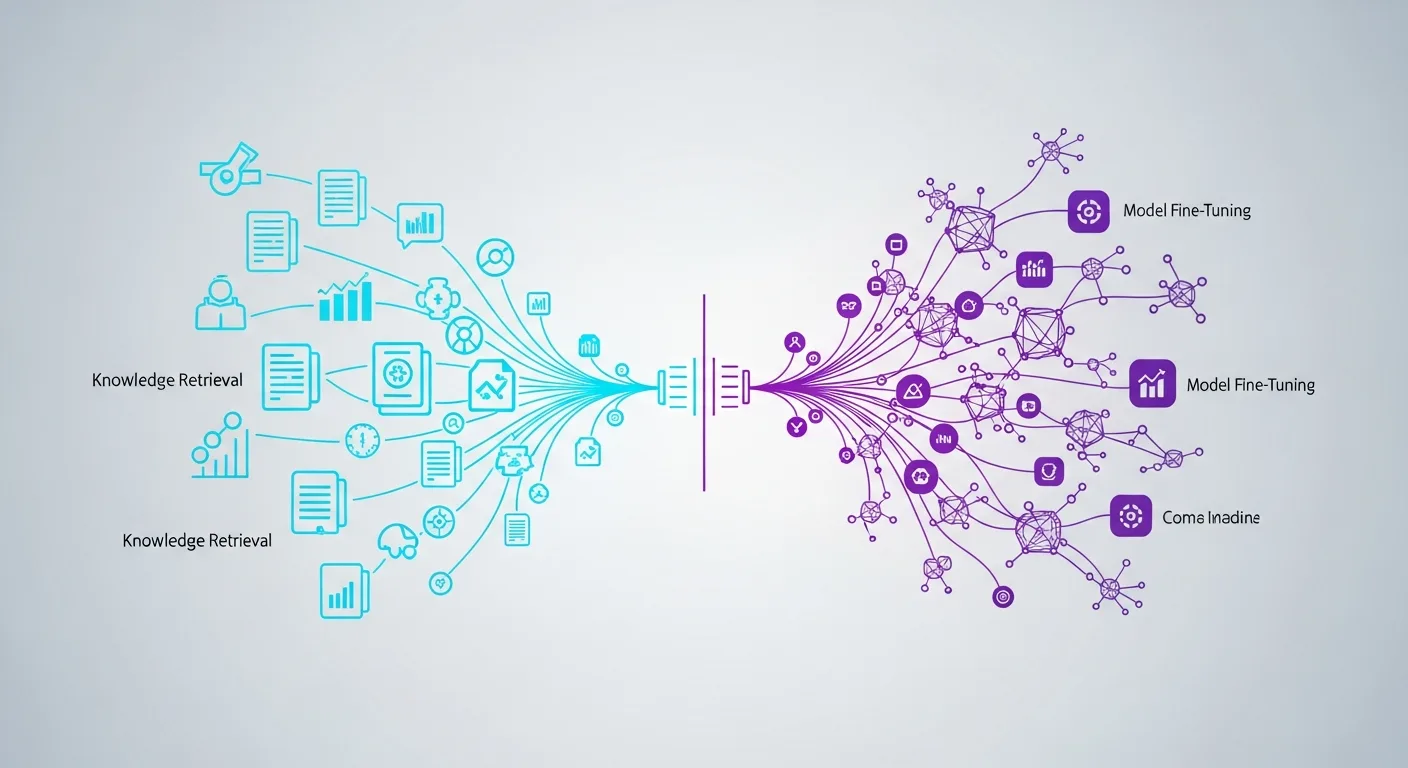
When enterprise teams decide to adapt a large language model to their specific domain, they quickly encounter two approaches: Retrieval-Augmented Generation (RAG) and fine-tuning. Both can dramatically improve LLM performance on domain-specific tasks. But they address fundamentally different problems, and choosing wrong is expensive.
What Is RAG?
RAG augments an LLM at inference time by retrieving relevant documents from a knowledge base and injecting them into the model's context window. The model never 'learns' the knowledge — it reads the relevant pages before answering, much like a consultant who looks up the policy manual before advising a client.
RAG is the right choice when your knowledge changes frequently, when you need citations and traceable sources, or when you are working with proprietary data that must stay within your security boundary.
What Is Fine-Tuning?
Fine-tuning updates the model's weights by training on a curated dataset of examples — question/answer pairs, instruction-response sequences, or demonstrations of desired behaviour. The model internalises patterns, tone, and domain vocabulary. It learns, rather than looks up.
Fine-tuning is the right choice when you need the model to adopt a consistent style or persona, when latency is critical (no retrieval step), or when the task involves structured output formats that generic models struggle with.
Head-to-Head Comparison
- Knowledge currency: RAG wins — retrieval stays current with your data. Fine-tuned models require retraining to reflect changes.
- Latency: Fine-tuning wins — no retrieval overhead at inference time.
- Data volume: RAG wins — works with any size knowledge base. Fine-tuning requires high-quality labelled examples (typically 1K–100K pairs).
- Consistency of tone/format: Fine-tuning wins — the model internalises style. RAG relies on prompting.
- Cost to update: RAG wins — update the vector store, not the model. Fine-tuning requires a new training run.
- Traceability: RAG wins — you can show which document the answer came from.
When to Use Both Together
The most sophisticated enterprise deployments use both: a fine-tuned model (for consistent tone and output format) augmented by RAG (for current, proprietary knowledge). The fine-tuned model knows how to answer; RAG ensures it has the right information to answer with.
A global legal firm we worked with uses a fine-tuned model calibrated to their review style (concise, structured, jurisdiction-aware) combined with RAG over 4M+ pages of case law and internal precedents. Neither approach alone would have achieved the accuracy required.
A Decision Framework
- 1Does your knowledge change more than monthly? Start with RAG.
- 2Do you need consistent tone, persona, or structured output? Consider fine-tuning.
- 3Is latency under 500ms a hard requirement? Fine-tuning or aggressive caching.
- 4Do you need to show your work (citations, source documents)? RAG.
- 5Do you have fewer than 500 high-quality training examples? RAG first; fine-tune later.
The worst decision is treating this as a binary, permanent choice. Start with RAG — it is faster to implement and easier to iterate. Add fine-tuning once you have signal on the failure modes that retrieval alone cannot solve.
Inspire AIQ's leadership team brings deep expertise in enterprise Agentic AI — helping organisations design, build, and deploy autonomous AI systems that deliver measurable ROI at scale.
Ready to put this into practice?
Our team builds enterprise-grade Agentic AI systems. Book a free consultation to explore what's possible for your organisation.